

In August of 216 BC, at the Battle of Cannae, ancient Rome suffered one of its most crushing defeats. The great Carthaginian general Hannibal had brought an elite army from Spain, over the Alps, and down into Italy, inflicting immense losses on Rome at the battle of the Trebbia, at the battle of Lake Trasimene,1 and then at Cannae, where Hannibal managed to execute a complex, double-pincer encirclement that destroyed multiple legions.2 Something like 50,000 Roman soldiers were killed and another 15,000 were captured, making it one of the more deadly battles of ancient history.3
Cannae was part of the second of three wars fought between Rome and the north African city-state of Carthage. Around 50 years before Cannae, the Roman and Carthaginian spheres of influence had collided in Sicily. Rome had done relatively well in the first war but was now faring very, very badly:
[...] the eyes of all were now turned to the Carthaginians, who had great hopes of even taking Rome itself at the first assault. The Romans on their part owing to this defeat at once abandoned all hope of retaining their supremacy in Italy, and were in the greatest fear about their own safety and that of Rome, expecting Hannibal every moment to appear. It seemed indeed as if Fortune were taking part against them in their struggle with adversity and meant to fill the cup to overflowing [...]
(All quotes are from Polybius’s Histories, via Bill Thayer’s LacusCurtius. This was Chapter 3, section 118.)
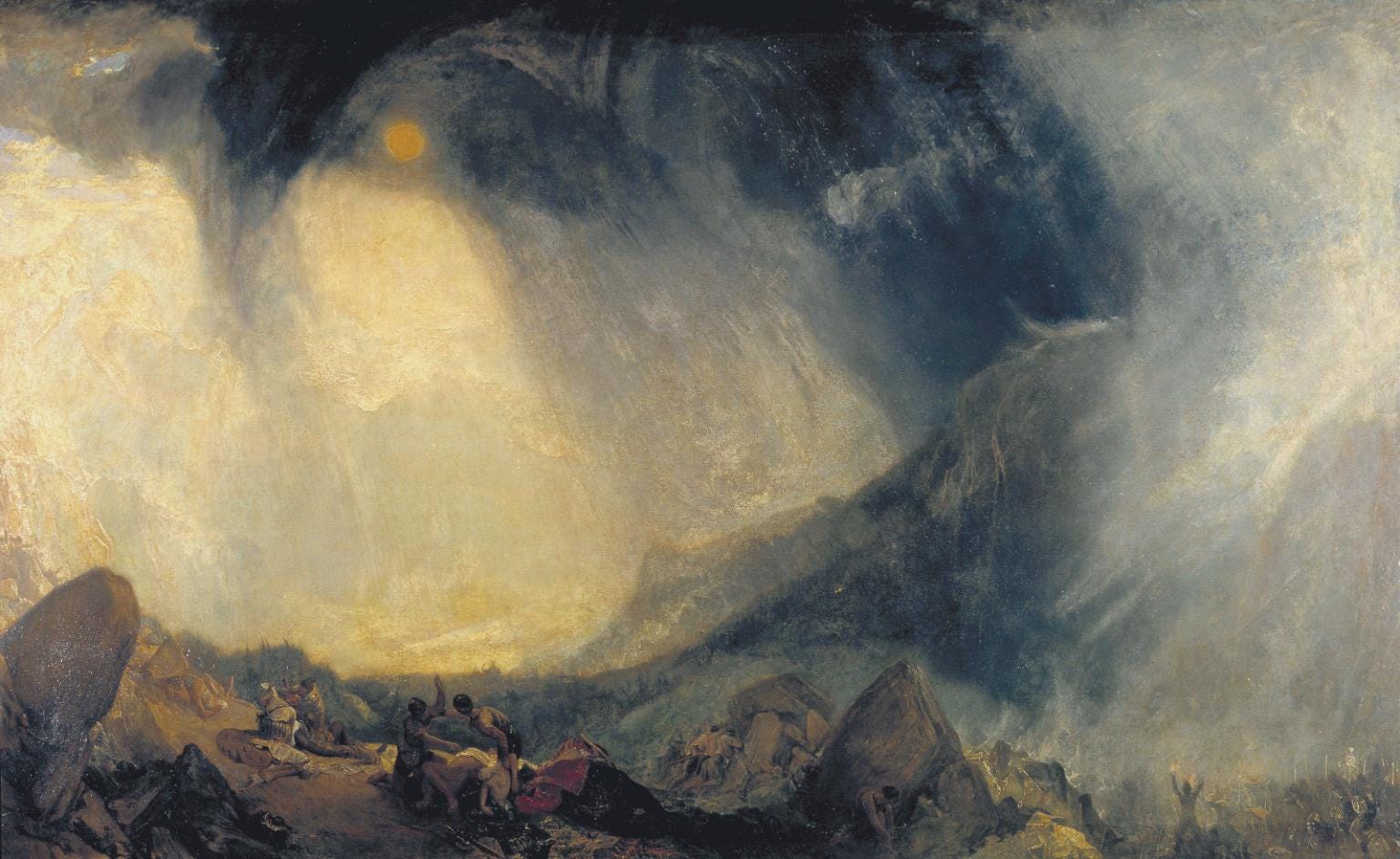

Hannibal never actually besieged Rome, but he actually didn’t need to, to achieve his overall strategy. Carthage wasn’t out to kill all Romans. They “just” wanted economic and military hegemony over the Mediterranean, specifically in north Africa, Spain, and Sicily. One way they could do that would be to convince cities in the Italian peninsula to ally themselves with Carthage, changing Rome from a leading superpower to one squabbling city-state amongst many.
It can be tempting to project our understanding of politics and war backward in time, thinking about Hannibal’s war as something like World War II, or maybe the American Civil War, or even the Napoleonic Wars, where nation-states conscripted their citizens and aimed to destroy the enemy’s war-enabling economic engine.
In fact, Rome and Carthage were not nation-states but city-states. At this point in history, the only Roman citizens were the people who lived in Rome.4 Other people in Rome’s sphere of influence were citizens of their individual cities, which were in turn allied with Rome. Allied cities maintained their own militaries that would, ideally, resist the Carthaginians.
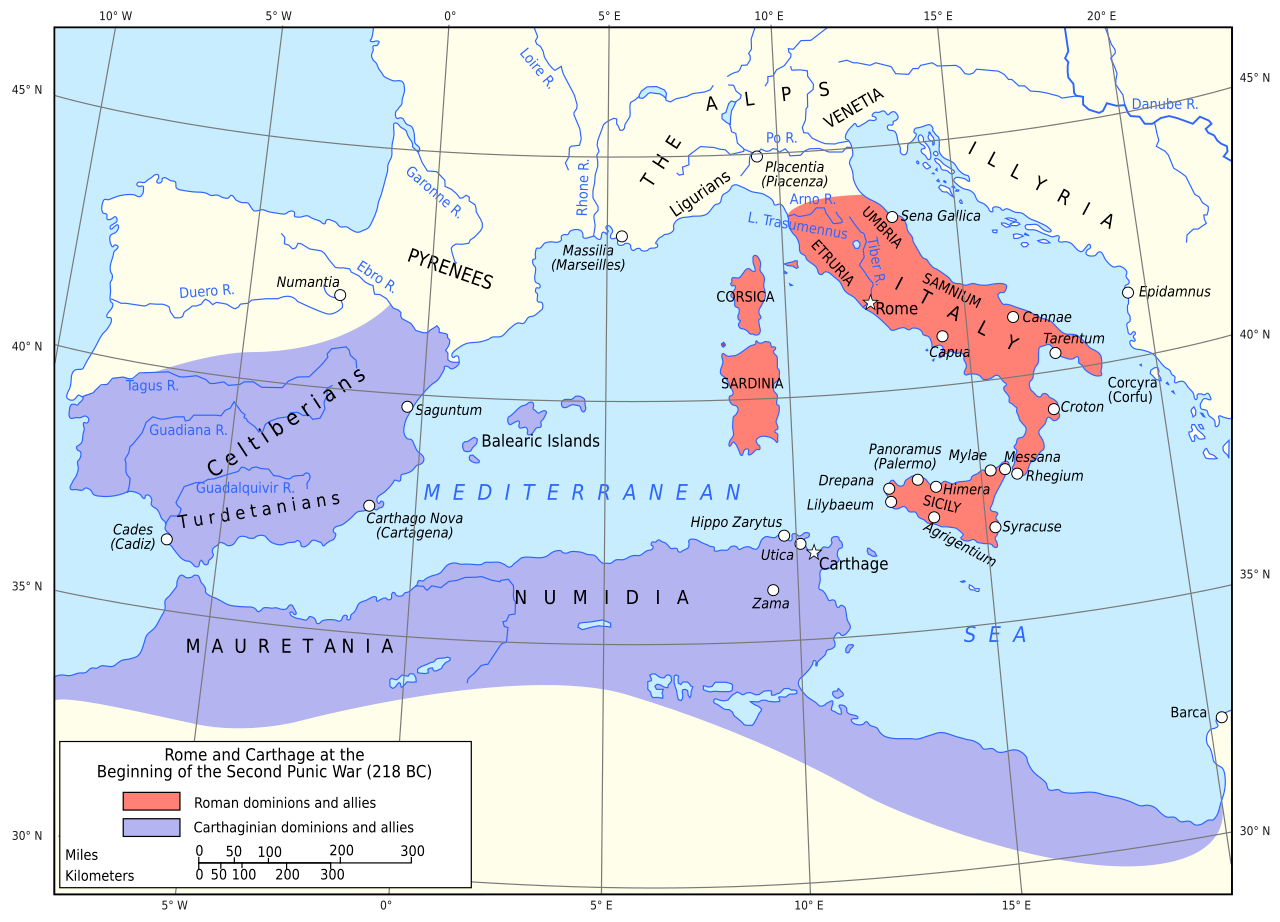

Rome’s alliances were strong but not unbreakable.5 Hannibal didn’t need to burn the city of Rome to the ground. He just needed enough of Rome’s allies to desert so that Rome could no longer project power outside Italy.
In other words, Hannibal was out to win hearts and minds. His treatment of Romans and Roman allies after one battle exemplifies this:
Hannibal [...] kept the Roman prisoners he had taken in the battle in custody, giving them just sufficient to eat, but to the prisoners from the allies he continued to show the greatest kindness, and afterwards called a meeting of them and addressed them, saying that he had not come to make war on them, but on the Romans for their sakes and therefore if they were wise they should embrace his friendship, for he had come first of all to re-establish the liberty of the peoples of Italy and also to help them to recover the cities and territories of which the Romans had deprived them. Having spoken so, he dismissed them all to their homes without ransom, his aim in doing so being both to gain over the inhabitants of Italy to his own cause and to alienate their affections from Rome, provoking at the same time to revolt those who thought their cities or harbours had suffered damage by Roman rule. (3.77)
Hannibal wanted to fight Romans in battle and defeat them, not so much that the Romans themselves would give up, but so that the Roman allies would notice their weakness and change sides.
Hannibal [...] made a bold dash at Falernum in the plain of Capua, counting with certainty on one of two alternatives: either he would compel the enemy to fight or make it plain to everybody that he was winning and that the Romans were abandoning the country to him. Upon this happening he hoped that the towns would be much impressed and hasten to throw off their allegiance to Rome. For up to now, although the Romans had been beaten in two battles, not a single Italian city had revolted to the Carthaginians, but all remained loyal, although some suffered much. From which one may estimate the awe and respect that the allies felt for the Roman state. (3.90)
Unfortunately for Hannibal, the Romans kept their heads after Cannae, and their leaders doubled down on the war, and the allies held the line with them, with a few exceptions. Hannibal lost the initiative and ended up spending 16 years in Italy, always hoping but never quite able to drive a wedge between Rome and the allies.
Hannibal’s Italian campaign was only possible because of Carthage’s prior conquest of Spain, which provided the money and manpower Hannibal used. As the years wore on, Carthage started to take Spain for granted, and the Romans realized their own opportunity to drive a wedge between a superpower and its allies:
[...] two of the greatest princes in Spain […] were supposed to be the most trusty adherents of Carthage, but they had long been disaffected and were watching for an opportunity of revolt, ever since [Hasdrubal, the Carthaginian general governing Spain] had demanded from them the payment of a large sum of money and the surrender of their wives and daughters as hostages. Thinking that the present time was favourable, they left the Carthaginian camp with all their forces by night and withdrew to a strong position where they would be in safety. Upon this most of the other Iberians also deserted Hasdrubal. They had long been offended by the arrogance of the Carthaginians, but this was the first opportunity they had of manifesting their inclinations.
The same thing has happened before to many people. For, as I have often said, while success in policy and victory in the field are great things, it requires much more skill and caution to make a good use of such success. So that you will find that those who have won victories are far more numerous than those who have used them to advantage. This is exactly what happened to the Carthaginians at this period. For after having defeated the Roman forces [in Spain...], they regarded their position in Spain as undisputed and treated the natives in an overbearing manner. In consequence their subjects, instead of being their allies and friends, were their enemies. And quite naturally; for they fancied that there is one method by which power should be acquired and another by which it should be maintained; they had not learnt that those who preserve their supremacy best are those who adhere to the same principles by which they originally established it, and this although it is evident and has been observed by many that it is by kind treatment of their neighbours and by holding out the prospect of further benefits that men acquire power, but when having attained their wish they treat their subjects ill and rule over them tyrannically it is only natural that with the change of character in the rulers the disposition of their subjects should change likewise, as actually happened now to the Carthaginians. (10.36)
Rome sent its best general, Scipio Africanus, to Spain. He trounced the Carthaginians and “liberated” the locals. Scipio then went on to North Africa, where Rome had managed to get the Numidians, nomadic horsemen who lived in present-day Algeria, to defect from the Carthaginians. Carthage recalled Hannibal from Italy, but Scipio had sufficient military genius to defeat even Hannibal and his die-hard veteran soldiers.
In other words, the battles in this war were the leverage, not the force. Hannibal gambled that winning key battles would drive the allies away from Rome. This is perhaps the inverse of a proxy war: in a proxy war, the great powers fight each other via some lesser powers, like how the US and Soviet Union supported opposing sides in Afghanistan and Vietnam, or how the French supported American colonists in the American Revolution. But in this Rome-Carthage war, the great powers fought each other directly, in the hopes that they would convince a landslide of smaller powers to stick with them.
The inverse proxy war might seem irrelevant today, when great powers like the United States can project force over vast distances. The US can blow up a jeep, or apprehend a head of state, almost anywhere in the world.
But to actually occupy a place is really hard. That’s not about winning a limited number of battles but about maintaining a supply of fighters, weapons, and strength of will:
For [Hannibal’s] forces had been trained in actual warfare constantly from their earliest youth, they had a general who had been brought up together with them and was accustomed from childhood to operations in the field, they had won many battles in Spain and had twice in succession beaten the Romans and their allies, and what was most important, they had cast to the winds everything else, and their only hope of safety lay in victory. The circumstances of the Roman army were the exact opposite [...] These advantages of the Romans lay in inexhaustible supplies of provisions and men. (3.89)
Victory isn’t about killing all of the enemy; it’s about creating the environment you want to live in. Rome wanted an allied Italy; Hannibal wanted a fractured Italy. The result wasn’t decidedly on a battlefield like at Cannae, but in the hearts and minds of Rome’s allies.
I wrote one of my first posts on this blog about the related Battle of Lake Trasimene.
Military strategists and ancient history nerds go crazy for Cannae, trying to glean special tactical wisdom from a few dozen lines written down by a single historian. Apparently it is, for example, General Schwarkopf’s favorite battle.
Adjusting for the size of the supporting population, Rome’s loss at Cannae was comparable to the loss of American life at Gettysburg, or in all of World War II, but in one day.
Allies could have various types of rights in the Roman legal system. True Roman citizens had the strongest rights, followed by Latins, then socii and foederati (whence the English “federation”). If the Roman system of graduated rights seems strange, consider that both in Rome and until recently in the United States men and women had different rights, and it is still the case that non-citizens had certain, although much lesser, rights under American law. The idea that there should be only kind of citizen is integral to the concept of a nation-state and would have been very foreign to the ancient Romans.
More than a hundred years after Cannae, Rome would fight a war against their closest neighbors.