

Marcus Didius Julianus, who became the emperor of Rome in 193 AD, is most famous for how he won the throne: by auction.
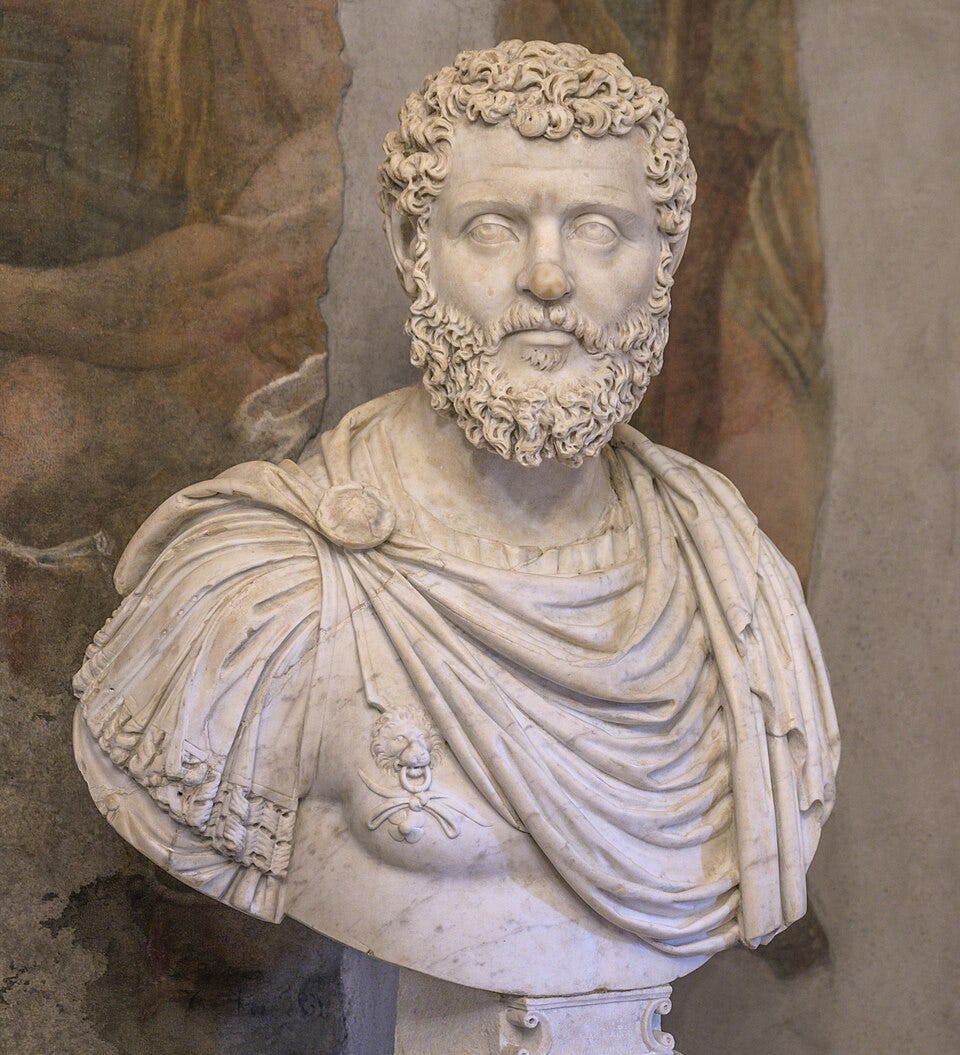
Didius Julianus came from a good family and had climbed the political ladder, distinguishing himself as a general and administrator. His ascent was stymied by the previous emperor Commodus who, in the end, was drowned in the bath by a professional wrestler. (Commodus’s mistress had discovered that Commodus had planned to have her executed, and she hired the wrestler-assassin for a pre-emptive strike.)
Into the resulting power vacuum stepped the Praetorian Guard, an elite military group based inside the city of Rome:
[The Praetorians] made proclamation that the empire was for sale, promising to hand it over to the man who offered the highest price, and promising to conduct the purchaser safely to the imperial palace under the protection of their arms.
When they made this proclamation, the more august and respected senators, those who were nobly born and still wealthy, the scattered survivors of Commodus’ tyranny, did not go to [the Praetorians’ camp]; they had no desire to use their wealth basely and shamefully to buy the empire.
But the praetorians’ proposition was reported to a man named Julianus while he was giving a dinner in the late afternoon amid much drinking and carousing. This Julianus had already served a term as consul and was thought to be a very wealthy man; he was one of the Romans censured for an intemperate way of life.
Then his wife and daughter and a mob of parasites persuaded him to leave his dining couch and hurry to the wall of the [Praetorians’] camp to find out what was going on. All the way to the camp they urged him to seize the prostrate empire; he had plenty of money and could outbid anyone who opposed him.
And so, when they came to the wall, Julianus shouted up a promise to give the praetorians everything they wanted, assuring them that he had plenty of money, that his strongboxes were crammed with gold and silver. [...]
Lowering a ladder, they brought Julianus up to the top of the wall, for they were unwilling to open the gates until they knew how much he would pay for the empire.
When he came up, Julianus promised [...] to give each soldier more gold than he asked for or expected to receive.
Convinced by his promises and delighted with their expectations, the guard proclaimed Julianus emperor [...] Then, raising their standards, to which pictures of Julianus had been attached, they prepared to escort the emperor to the imperial palace.1
How did it come to this? Less than a hundred years before, Rome was in the middle of its golden age, and now the throne was being sold off.
Naturally the answer is “it’s complicated,” but I want to focus on just one element: the Praetorian Guard.
The word “praetorian” comes from praetorium, the word for the tent of a Roman general on campaign. Although there was an official system for soldiers in the legion to post guards at the praetorium, the general might have his own personally procured bodyguard, a “praetorian guard” in the literal sense.
In 40 BC, Octavian, the man who would later go on to become the first emperor Augustus, was co-ruling Rome with his two frenemies. In part to protect himself against his colleagues, he posted his praetorian guard inside the city of Rome.
This was an enormous breach of precedent. In Rome’s early history, legions were mustered for one summer of warfare against close neighbors and then disbanded. Later, Rome’s military became a professional, standing army, but soldiers were fighting wars throughout the empire and rarely came to the city of Rome itself.

Over Octavian-become-Augustus’s reign, his praetorian guard evolved into the Praetorian Guard, progressing from a bodyguard into a kind of military police and counterespionage unit. By the time the second emperor Tiberius quasi-retired from public life, the Praetorians had accreted so much power that the head of the Praetorians, Sejanus, was essentially in charge of the empire:
[Tiberius] warned the public by an edict not to disturb his retirement and posted soldiers here and there to keep off the throngs of townsfolk. But he so loathed the towns and colonies and, in short, every place on the mainland, that he buried himself in the island of Capreae which is separated by three miles of strait from the [mainland]. The solitude of the place was, I believe, its chief attraction [...] It commanded too a prospect of the most lovely bay, till Vesuvius, bursting into flames, changed the face of the country. [...] Tiberius had by this time filled the island with twelve country houses [...] Intent as he had once been on the cares of state, he was now for thoroughly unbending himself in secret profligacy and a leisure of malignant schemes.2
In 31 AD, Sejanus attempted a coup, which Tiberius defeated, in part by giving the Praetorians a “donative.” This word is an English translation of the Latin donativum, which literally means “gift” but which has come to refer specifically to the money given to the Praetorian Guard to buy their loyalty.
Starting with Tiberius’s donative, it became standard for new emperors to give the Guard a donative to ensure their loyalty. The one-time donative upon accession morphed into more regular “gifts.” From there it’s not too hard to see how we end up, 150 years later, with the auction won by Didius Julianus.
In summary, there are many potential problems with posting military units in the capital.3
Herodius 2.6 (via Livius.org)
For clarity, the “Warrior Dividend,” while branded as new money given to soldiers, is in fact a reallocation of housing allowances originally intended to be spread over many years.