

I always find Christmas a bit weird. It is the most specific time of the year. There are particular songs that play on the radio, particular colors one is supposed to wear, particular foods, particular greetings, and particular social event themes. Every year I sit in a building and hear someone talk about how our particular god made himself into a particular human, and that this particular story is important.
I find this particularity absurd, in the existential sense. Of all the possible worlds we could live in, I live in one where the song I hear most often this year was one by Mariah Carey about hearts. I live in one where there is a thing called a church that has pictures of humanoids with wings and, for only one month per year, also has trees in it. I live in one where I was born into a religion whose sacred liquids are water, oil, and wine. What will we do when we go to planets that don’t have any of these things?

At Christmas I have a hard time doing what I call “delighting in the world that is.” My literary touchstone for this sensation are Tolkien’s elves:
The doom [i.e., fate, which in Tolkien’s archaic usage isn’t necessary bad] of the Elves is to be immortal, to love the beauty of the world, to bring it to full flower with their gifts of delicacy and perfection, to last while it lasts, never leaving it even when “slain,” but returning – and yet, when the Followers [i.e., humans] come, to teach them, and make way for them, to “fade” as the Followers grow and absorb the life from which both proceed. The Doom (or the Gift) of Men is mortality, freedom from the circles of the world.
The elves are part of the world. Even when they “die,” they go to another part of it: “dying they are gathered to the halls of Mandos in Valinor, whence they may in time return.” The souls of humans, by contrast, leave the boundaries of creation. (It is a mystery, even to all the gods except the creator, where humans “go” and what will become of the elves when the world ends.)
Sometimes I can live in this kind of embedded wonder. Back when I had a backyard, my partner jestingly accused me of “plantgazing.” I would do some kind of yardwork but then just silently look at the plants, and marvel, and be still. This is the same sensation I have any time I pet my cat. Even after picking him up for the thousandth time, I delight in his catliness.
I contrast this delight-in-the-world with the transcendental sensation that comes when viewing a particularly arresting sunset, or fragment of nature, or work of human art. Transcending is about leaving the boundaries of creation; delight-in-the-world is decidedly bounded up in it.
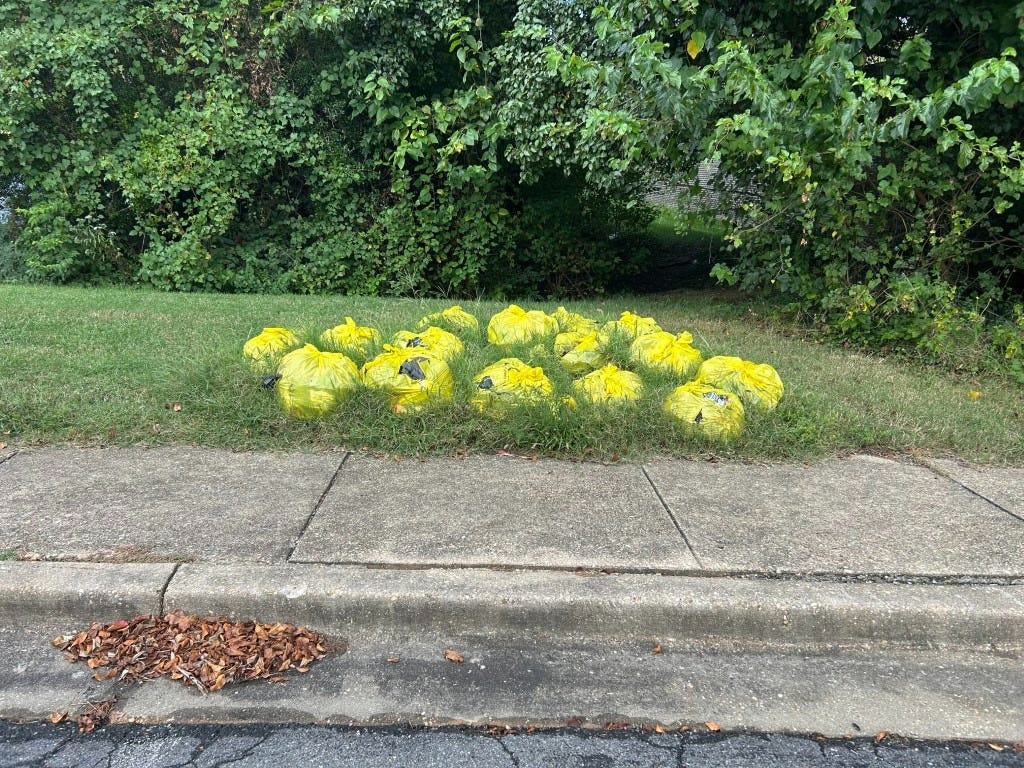
A surefire method for not delighting-in-the-world is to look at one’s phone. But that doesn’t mean looking up is always helpful. Unlike the elves, we rarely build our roads, homes, and cities with delight-in-the-world. They usually seem to be made with the opposite. Nothing is worse to me than a patch of hard-packed dirt, wedged between broken concrete slabs, speckled with some small pieces of trash, like one-time-use flossers.
Delighting in the world must also entail humanism. One cannot delight in the world except via the body, and that body must be loved for what it is. I’m one of those cerebral people who by habit thinks of themselves as a sort of brain in a vat with a bipedal motor system attached to it. It takes work to overcome that Cartesian dualism.
I expect it also takes work for cerebral people —who by habit think of human existence as a series of interactions in spheres, like economic spheres, and family spheres, and so forth— to value humans in and of themselves. Last Christmas, the Greek Orthodox Patriarch Bartholomew of Constantinople had this to say in his Christmas encyclical:
Today there is much talk about “the metahuman” and praise of artificial intelligence. [...] The concept of “the metahuman” is based on technological progress and his equipment with means previously unimaginable to human experience and history, through which humankind will be able to transcend currently valid human measures. The Church is not technophobic. It approaches scientific knowledge as “a divinely granted gift to human beings,” without however overlooking or suppressing the dangers of scientism. The Encyclical of the Holy and Great Council of the Orthodox Church [...] also emphasizes the contribution of Christianity “to the healthy development of secular civilization,” since God “established human beings as stewards of sacred creation and His coworkers in the world.” [...]
The answer to the crucial question—namely, how can we preserve the “culture of personhood,” the respect for its sacredness and emphasis on its beauty, until the final “eighth day” in the face of the titanism1 and prometheanism2 of the technological culture, its evolution and transmutation, in the midst of anthropotheistic changes and exaggerations of humankind—has been given once for all in the mystery of Divine Humanity. God the Word became flesh [...]
Unsurprisingly, the head of a church says that the way out of the pickle of titanism and prometheanism is religion, specifically, by remembering that god became human.
The rest of us must find some other way. The closest I’ve come is via John Ruskin, foremost art and social critic of Victorian England. Here is part of his address for the opening of the Cambridge School of Art (now Anglia Ruskin University), which emphasized drawing:
[W]e shall obtain no satisfactory result, unless we [...] set ourselves to teaching the operative, however employed–be he farmer’s labourer, or manufacturer’s; be he mechanic, artificer, shopman, sailor, or ploughman–teaching, I say, as far as we can, one and the same thing to all; namely, Sight.
Not a slight thing to teach, this: perhaps on the whole, the most important thing to be taught in the whole range of teaching. To be taught to read—what is the use of this, if you know now whether what you read is false or true? To be taught to write or to speak—but what is the use of speaking, if you have nothing to say? To be taught to think—nay, what is the use of being able to think, if you have nothing to think of? But to be taught to see is to gain word and thought at once, and both true.
Nonconformism; rebellion against prevailing social and artistic conventions, especially when it involves grandiosity or hubris; with an overtone of Titans, the gods who were overthrown and replaced by Zeus and the other Olympians.
Involving attitudes or approaches that are daringly original or boldly creative. Again, with an overtone of a god that came to a bad end.
Love it!