

A few years ago, I started to ask my fiscally minded friends a question, one that sounds simple but turns out to be very complicated: why is a stock worth what it’s worth?
I never got an answer I could really make sense of. So I went to the library, and I made a new friend: Joseph de la Vega. He wrote the first book about a stock exchange, the aptly named Confusion of Confusions.
De la Vega was a Spanish-speaking Portuguese Jew who lived in Amsterdam in the 1680s. He saw the hustle and bustle around the Amsterdam Exchange, where shares in the Dutch East India Company, or VOC,1 were traded. The VOC was the first publicly-traded company in the sense we understand it now.
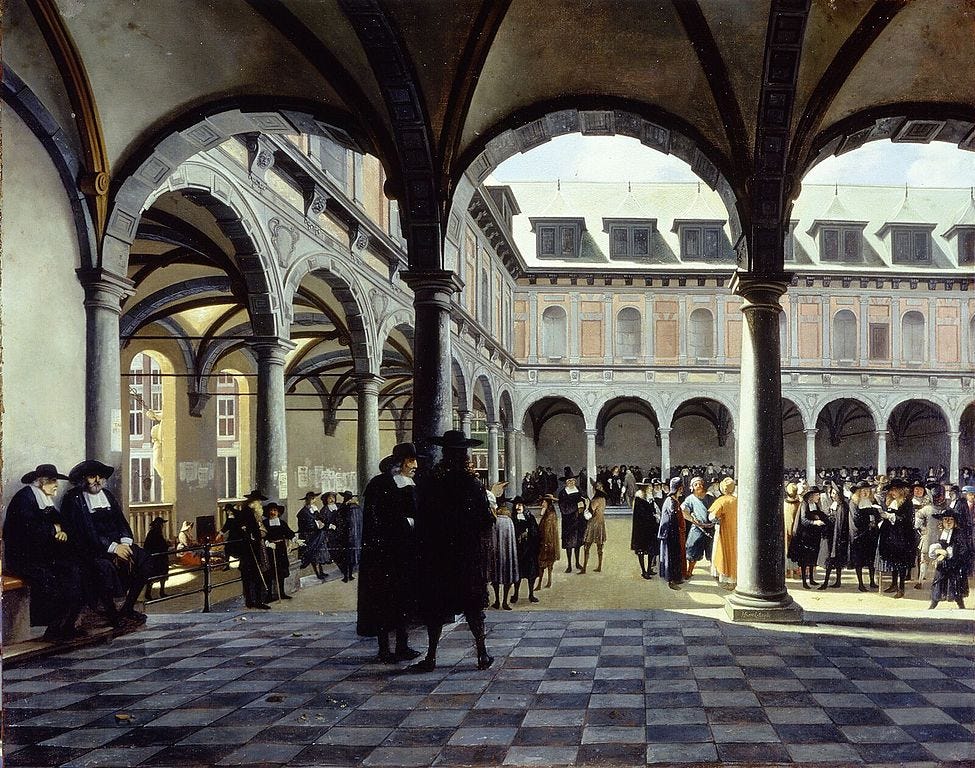

In one sense, the Exchange in the book was much simpler than the stock exchanges we have now, since basically only a single stock was traded: shares in the VOC.2
And those shares were also relatively straightforward, at least in the early days of the Company: you put your money into a pool, the Company used that money to outfit a trading expedition to Southeast Asia, and then they paid out the profits of that expedition to shareholders as dividends.
So clearly the stock’s price was rooted in the profitability of the Company. More profits means more dividends means more expensive shares:
In order that you should not come to the conclusion that the movements of the stock exchange are inexplicable and that nothing is firm, take note and realize that there are three causes of a rise in the prices on the exchange and three of a fall: the conditions in India, European politics, and opinion on the stock exchange itself.
But dividends don’t explain that much of the variability in the VOC stock price, in part because of the high price of individual shares. Unlike today, where a typical price for a share in a typical company is about $100, the individual East Indian Company shares were very expensive: equivalent to about hundreds of pounds of pure silver.3
This high share price means that only very few people, who de la Vega calls “princes” and “financial lords,” can actually afford to own shares and live off the dividends. These people didn’t drive stock prices because they usually had no interest in selling off one of the most successful forms of passive income that had ever existed.
Instead, many people were “gamblers and speculators” who made bets on the changes in the price of shares. In a word, these people made futures contracts (as well as other derivatives like options).4
If you don’t know how futures contracts work, here’s an example: I’m a speculator who thinks the price of the stock will go up from its current value of 500 pounds,5 but I don’t have 500 pounds to buy a share. So I find a merchant, who has a share and wants money, and make this deal: on the first day of next month, I’ll give the merchant 500 ducats, and he’ll give me the share.
Luckily, as time goes on, the stock price goes up, so I find another merchant, who has money but no shares. With the second merchant, I make this deal: on the first day of next month, I’ll give you one share, and you’ll give me 510 pounds.
Then, on the first of the month, I pass the share from the first merchant to the second, and I pass 500 pounds from the second to the first, and I put the remaining 10 pounds in my pocket.6
Of course, if I had made the wrong bet, I might need to take 10 pounds out of my own pocket to make the deals work out. And this is where things get interesting, since the financial success of the speculators depends on what other people think the stock will be.
Maybe because there was only one stock to trade, traders and brokers aligned themselves into two camps: the bulls, who always wanted the price to go up, and the bears, who always wanted it to go down.
These groups appear to be fairly organized and very devious. There were very few restrictions, legal or otherwise, on trading, so bulls and bears would create fake news, corner the market, exhaust the money supply, or do anything to get their way. De la Vega lists at least 12 bear strategies. For example:
[T]he syndicate [of bears] borrows all the money available at the Exchange and makes it apparent that it wishes to buy shares with this money. Afterwards, however, large sales are executed. Thus two birds are killed with one stone. First, the Exchange is supposed to believe that the original plan is altered because of important news [i.e., suggesting that external events will soon cause prices to rationally fall]; secondly, bulls are prevented from finding money for hypothecating [mortgaging] their shares. They are, therefore, compelled to sell, since they do not have the money to take up the stock [and prevent the appearance that no one wants to buy, which would further drive down prices …]
My personal favorite tactic is from the bulls:
Our speculators frequent certain places which are called [...] coffee-houses because a certain beverage is served there called coffy by the Dutch [...] The well-heated rooms offer in winter a comfortable place to stay, and there is no lack of manifold entertainment. You will find books and board games, and you will meet there with visitors with whom you can discuss affairs. One person takes chocolate, the others coffee, milk, and tea; and nearly everyone smokes while conversing. [...] while one learns the news, he negotiates and closes transactions.
When a bull enters such a coffee-house during the Exchange hours, he is asked the price of the shared by the people present. He adds one or two per cent to the price of the day and he produces a notebook in which he pretends to put down orders. The desire to buy shares increases; and this enhances also the apprehension that there may be a further rise [...] Therefore, purchase orders are given to the cunning broker. But, in order slyly to reach his own objectives, he replies that he has so many other orders that he cannot be at anyone else’s disposal. The naive questioner believes in the sincerity of the statement; his desire to buy becomes even more ardent [i.e., driving up prices...]”
But it doesn’t even take trickery per se for prices to swing. De la Vega notes that every piece of good news, such as information about a successful expedition, causes its own small bubble in the price:
The expectation of an event creates a much deeper impression upon the exchange than the event itself. When large dividends or rich imports are expected, shares will rise in price; but if the expectation becomes a reality, the shares often fall; for the joy over the favorable development and the jubilation over a lucky chance have abated in the meantime. [...] But as soon as the ships arrive or the dividends are declared, the sellers [i.e., the bears] take new courage. They calculate that for some months the purchasers —the bulls— will not be able to expect very propitious events. So the leaves tremble in the softest breeze, and the smallest shadow causes fear — and therefore no wonder that the shares fall, because they are abandoned by the one side and are attacked by the other.”
These stories gave me a lot of comfort. Clearly, somewhere, deep down, stock prices have some rational basis in the world. If a company is profitable, and they pay dividends, or I get a controlling share, then I can put some of those profits in my pocket. But for the most part, the value of a single share is whatever someone is willing to pay for it, even though they might also not be in a position to skim profits.
If 300 years ago, a stock market with a single stock could cause Confusion of Confusions, I shouldn’t be surprised that someone on the Internet can make GameStop’s stock price shoot up or down, nor that the global economic slowdown caused by the pandemic wouldn’t depress stock prices.
Instead, I should take de la Vega’s personal advice. First, don’t give advice about trading. Second, be happy with the gains you have rather than be sad about the gains you missed. Third, remember:
Profits on the exchange are the treasures of goblins. At one time they may be [gems], then coals, then diamonds, then flint-stones, then morning dew, then tears.

The Dutch is Vereenigde Oostindische Compagnie. We use “VOC” to distinguish it from the British East India Company, or EIC.
Dutch West India Company stock was also traded in de la Vega’s time, but that company was younger and less successful, and its stocks were organized in a way that made them less susceptible to speculation, compared to the VOC.
De la Vega quotes a typical face value of a share at 500 pounds (Flemish), or 3,000 guilders, but the market rate was much higher, at around 17,000 guilders. A guilder was worth 10 grams of silver in de la Vega’s time.
This shouldn’t come as a surprise; people had been making speculative trades on commodities for a long time. For example, the tulip craze also took place in the Netherlands at the same time as East India Company stock was speedily increasing in value. There were tulip commodities futures but no tulip stocks.
These are pounds Flemish, equal to 6 Dutch guilders.
Finance+history nerds would like this book, since the reality was more complicated. For example, de la Vega spends many pages on a form of effective bankruptcy: selling short was technically illegal, so a person who had sold short could always back out of a short position by denouncing the contract. This relieved them of their obligation but damaged their business reputation to a degree that they might not be able to continue trading.