

Before we got divorced, my ex-wife and I planned a trip to Japan. We would hike from village to village in the Kii peninsula, south of Kyoto. We would hike over mountains in the day and soak in riverside hot springs at night. The trip fell through, and our marriage dissolved. Years later, I went to Japan with a friend. We separated for a few days so I could undertake the journey I had planned with my ex.
The hiking routes in that part of Japan were originally medieval pilgrimage routes. The emperor and hundreds of his retainers walked from Kyoto to the major Shinto shrines in Kii, performing ritual ablutions at each river and shrine. In Shintoism, humans are considered fundamentally clean. Each ritual wash removes a layer of extraneous pollution, sin, and guilt.
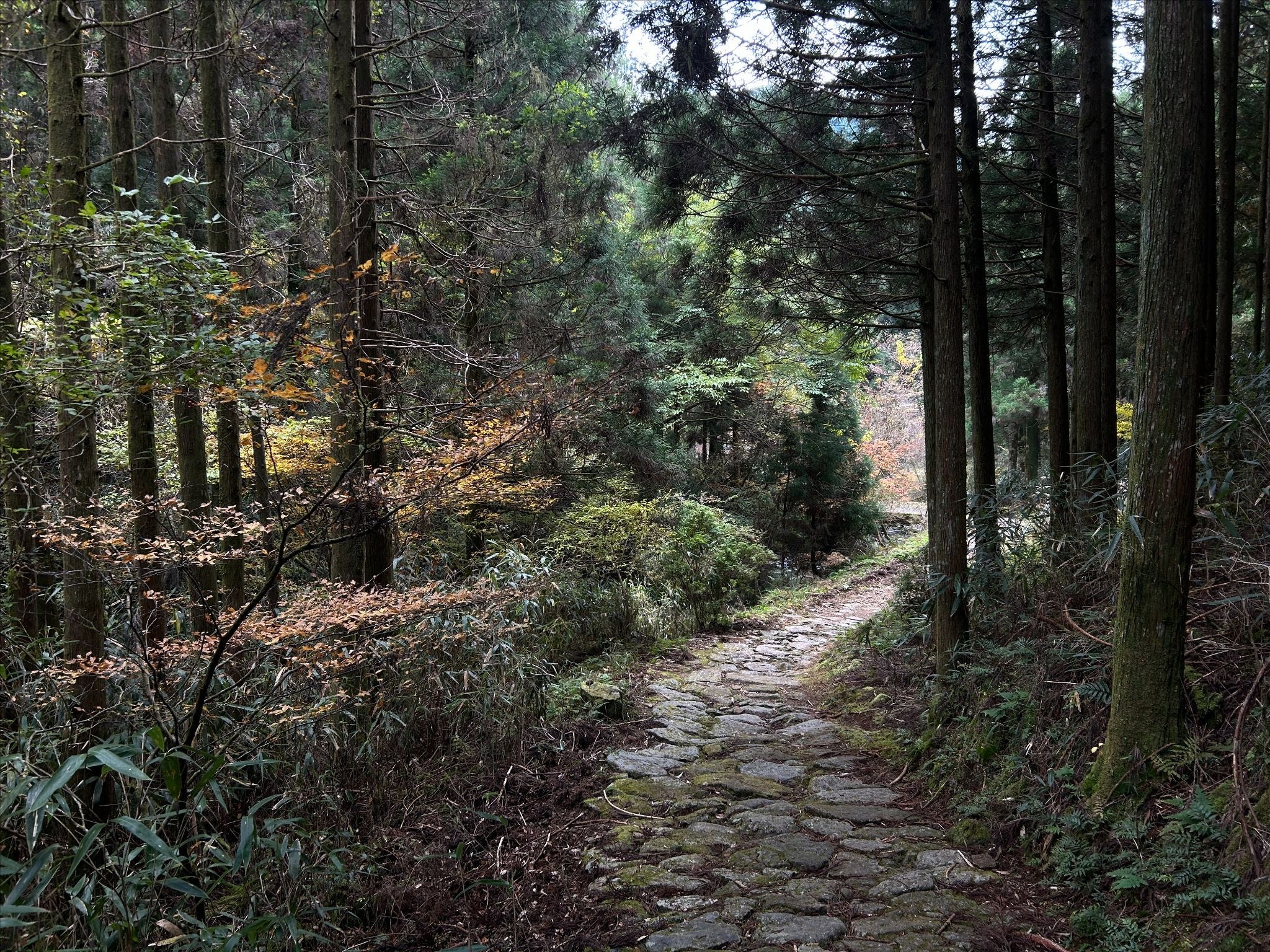
The modern route begins at a small shrine, next to a rocky river, at the base of a thickly forested hill. I was the only one who got off the bus at the shrine. It was a perfect autumn day. There was a light breeze. Yellow, newly fallen leaves scraped over the cobbles that formed the path to the shrine.
My guide book instructed me what to do. I performed the ritual washing, clapped twice to call the attention of the local spirit, and bowed. Then, I began to sob. Divorce had left me covered with many polluting layers. I realized I was starting a pilgrimage.
Alone, in the woods, in the presence of a god I don’t believe in, I had a religious experience.
I tried to replicate the experience on a later trip. I was in England, walking part of the South Downs Way, a hiking path that runs through a national park, starting in the city of Winchester.
Outside Winchester Cathedral, I passed two columns of men, dressed in ecclesiastical black and white, carrying maces. There were old ladies with big hats. It was Pentecost, the feast commemorating the Holy Ghost’s descent upon the apostles. There came a sound from heaven as of a rushing mighty wind, and there appeared unto them cloven tongues like as of fire, and it sat upon each of them.
I went into the cathedral to rest and listen to the service. I saw more men, in more outfits. They processed. They intoned. In a church, in the presence of the god of my tradition, I could only think: “There is no god.”

In his Elementary Forms of Religious Life, Émile Durkheim proposes a theory for the origin of religion. Durkheim’s theory is different than most of the ones I can imagine most of us, not religion scholars, would come up with. (Notably, these layman’s theories are similar to many of the ones that were the leading hypotheses of 19th century thinkers, but have since been invalidated or de-emphasized.)
For example, it is not the case, Durkheim argues, that primitive man was afraid of thunder and imagined a thunder god. First, people who live in nature are not surprised by nature. They do not need a god to make sense of thunder any more than they need a god to make sense of gravity. “Science, not religion, has taught men that things are complex and difficult to understand.”
Second, religion cannot have originally been about god or gods because some religions, like Jainism and some kinds of Buddhism, don’t have gods. In fact, he argues, religion predates gods. Durkheim studied religion among Australian Aboriginals. Because the Aboriginals had very little technology, mostly stone tools, they were considered good proxies for early humans’ behavior. And the Aboriginals had no gods. Instead, they had totems. Each clan was defined by a totem, and the clan held that totem sacred, but a totem was not a god with its own powers.
Durkheim argues that the origin of the totem was a misapprehension. Early humans sensed that they were in the presence of something powerful and invisible, and they externalized this sensation in the totem.
The powerful and invisible thing those early humans sensed was society itself. A society is an indisputably powerful thing. It can destroy or exalt any of its members. It can overpower all other animals. It can achieve marvels. And yet, a society doesn’t really exist in any one place. You cannot point to it.
So if [the totem animal] is at once the symbol of the god and of the society, is that not because the god and the society are only one?
Durkheim argues that all other elements of religion, including gods, rituals, and even the solo experience I had at that shrine in Japan, are built on the foundation of the awe and reverence we have for one another, as a unit. In this way, the most primitive religions, which are based on reverence for human society, are more “real” than, say, Christianity. Human society is demonstrably real and powerful and invisible, while one must take it on faith that Jesus rose from the dead.
Since reading The Elementary Forms, I’ve been struck by how, despite living in a “modern” society, totems drive our behavior. The easiest example is patriotism. What is the United States, really? It is not land, or ideas, or really even people, but rather a set of relationships between people. My heart swells during “America the Beautiful,”1 partly because I think mountains are beautiful, but mostly because I mix up my aesthetic appreciation of mountains and waves of grain with my admiration for my fellow citizens and the sense that, when we put our minds to it, Americans can do great things.
Maybe your heart doesn’t swell with “America the Beautiful,” but maybe you do love New York City. And by “love” I don’t mean the superficial, touristic love, the pleasure that comes from having a concentration of things you like to consume within close reach. I don’t mean an aesthetic or architectural love for the buildings in the city. I mean love for the emergent and distinctive experience of New Yorkness, but for the special interplay between all the human actors that make the city what it is, for the piece of unique theater that is put on every day as people live their New York lives.2
Maybe you don’t love your country, or your city, but you do respect the law. Law is something powerful and invisible that exists between people. It has not power except through people. Law can’t stop you from killing someone, but it does compel other people to take action if you do. And your disrespecting the law injures something in me, because you have profaned what should be sacred. People don’t carry around pocket-sized copies of the Constitution because they need to study or consult the text.
A wise man recently told me that two things are true. First, I am but dust, and second, the world was made for me. One day I’ll figure out how to have a religion that squares the circle, where humans can worship and reverence humanity.
Can we get some more national anthems that are not plodding, nineteenth century orchestral pieces? Bonus points to Israel for using a minor key.
Before my first visit to Greece, I read Salonica, City of Ghosts. Salonica, now Thessaloniki, was once an astonishingly diverse and special city, approximately one third Greek, one third Turkish, and one third Jewish, descendants of Jews expelled from Spain during the Inquisition and invited to Salonica by the Ottomans who wanted to counterbalance the Greek population. When I visited Thessaloniki, I was on the same land, but the old city was gone. The Turks were expelled in 1922 during the Greco-Turkish War, and the Jews were sent to concentration camps when the Nazis occupied Greece.