

In 509 BC, Rome had expelled its kings and become a republic. The fall of the monarchy created tension with Rome’s neighbors, who fought wars with the Romans. The Romans won, but many people, including soldiers, had their farms and livelihoods destroyed. They were in debt to Rome’s wealthy aristocrats, the patricians, and were treated cruelly.1
Eventually, the common people, the plebs,2 decided some action must be taken. They considered assassinating the consuls. This plan was rejected because it would violate the sacred oath of loyalty the plebeians had sworn to the consuls as part of the last war.
Instead, the plebs held a general strike, leaving Rome and camping on a hill about three miles away. The city of Rome at this time covered about 1 square mile and had around 25,000 people, the vast majority of whom were plebeians. I struggle to imagine what it would have been like, to be a patrician, waking up to find that all your servants and employees had disappeared.
The patricians and the plebeians brokered a compromise: the plebeians would return to Rome, but the emerging Roman constitution would now have a new component: the tribune of the plebs.
The tribune would be elected by plebeians, and the office could only be held by a plebeian. The plebeians had a few powers, the most important of which was the jus intercessionis, literally, the “right to move between.”3 A tribune could physically put himself between a government magistrate, usually a patrician, and a plebeian, to prevent the magistrate from doing anything to that plebeian.
To give the jus intercessionis force, the tribune was made “sacrosanct,” meaning that their physical person was inviolable and sacred to the gods. To harm or interfere with a tribune was unholy. Anyone who did became accursed4 and could be killed with impunity. We have no direct analogues for this in our modern life, but I like to think about how touching a cop or resisting arrest immediately and drastically escalates a situation. The tribune would announce his intention to exercise jus intercessionis by shouting “Veto!” meaning “I forbid it!”
The Roman veto became associated with legislation because a tribune could obstruct a legislative assembly and prevent a vote from taking place. In the strictest sense, the tribune would need to go to the voting place and get in the way, but the threat of a veto could provide substantial leverage.5
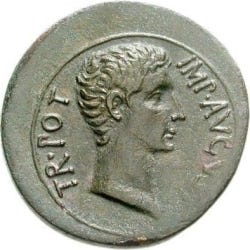
450 years later, the Roman Republic was crumbling in civil war. Julius Caesar, although a patrician and therefore ineligible for the tribunate, was given tribunicia potestas, the powers of a tribune. (In modern Washington, we might joke that he was Acting in the Capacity of Tribune of the Plebs.6) Augustus took on tribunicia potestas after him, helping him consolidate power into what would become the Roman emperorship. Thus a power exercised by the common people for their own protection was taken up by populist leaders, who assured the people they would exercise that power on their behalf.
1,500 years later, British monarchs would exercise royal dissent, also called the “negative voice,” preventing a legislative bill from becoming a law. Royal assent was a product of feudal European history and had no relation to ancient Rome.
By the time of the American Revolution, British monarchs had ceased to use royal dissent in Britain, but the monarch and their appointed governors used it extensively in the colonies. These interventions were maybe more important to the Revolution than more familiar ones like taxes and quartering of soldiers. The first two complaints against King George III in the Declaration of Independence were:
He has refused his Assent to Laws, the most wholesome and necessary for the public good.
He has forbidden his Governors to pass Laws of immediate and pressing importance, unless suspended in their operation till his Assent should be obtained; and when so suspended, he has utterly neglected to attend to them.
Quartering of soldiers and taxes are the fourteenth and seventeenth complaints, of 27 total.
Two American states experimented with giving their governors a power to block laws or to require a greater-than-majority vote. The American framers decided to give a law-blocking power to the President, but contemporary terms like “absolute negative” or “qualified negative” smacked of royal overreach. The word “veto” would have been familiar to the politically active, classically educated American elite of the time, but it had too strong of overtones. Only one Federalist paper uses the word “veto,” and it implies a too-powerful ability.
Article I Section 7 of the Constitution avoids these branding problems by describing a procedure but not giving it a name:
Every Bill which shall have passed the House of Representatives and the Senate, shall, before it become a Law, be presented to the President of the United States; If he approve he shall sign it, but if not he shall return it [...] to that House in which it shall have originated, who shall [...] proceed to reconsider it. [...]
Only in later decades, after the Constitution took effect, did the word “veto” come to refer to this power.
So although the ancient Roman veto and the modern American one have almost no historical connection, and there’s no sense in which we could reasonably swap in the Roman veto, I still prefer it. I like requiring the executive complete (or, at least, threaten to complete) an act of physical bravery, in the way that our filibuster requires a legislator to complete (or, at least, threaten to complete) an act of physical endurance.
Technically the debt crisis preceded the wars. It’s a complicated history.
The plebs is the group, and plebeians are the members of the group. It’s like how the aristocracy is composed of aristocrats (or, confusingly, how the elite is composed of elites).
Technically the tribunes had two separate rights, intercessio and auxilium. I’m describing a mix of both.
In Latin, sacer meant “sacred.” Confusingly, it also meant the complete opposite: accursed and reviled. The tribune was sacrosanctus; anyone who harmed or interfered with them was sacer, in the bad sense.
“When men, engaged in unjustifiable pursuits, are aware that obstructions may come from a quarter which they cannot control, they will often be restrained by the bare apprehension of opposition, from doing what they would with eagerness rush into, if no such external impediments were to be feared.” (Federalist no. 73)
“[...] he assumed the tribunician authority practically for life; for he secured the right of sitting with the tribunes upon the same benches and of being reckoned with them for other purposes — a privilege which was permitted to no one.” (Cassius Dio, Book 42, Chapter 20)